What Causes Market Volatility? sets the stage for this enthralling narrative, offering readers a glimpse into a story that is rich in detail with casual formal language style and brimming with originality from the outset.
Market volatility is a phenomenon that keeps investors and traders on their toes, with sudden shifts and fluctuations shaping the financial landscape. Understanding the root causes behind these market swings is crucial for navigating the unpredictable terrain of investments and trading.
Introduction to Market Volatility
Market volatility refers to the fluctuation of prices in financial markets over a period of time. It is a measure of the degree of variation in the price of a financial instrument, such as stocks, bonds, or commodities. Market volatility plays a significant role in the investment landscape as it can impact the returns and risk levels for both investors and traders.The impact of market volatility on investors and traders can be substantial.
High volatility can lead to large price swings, making it difficult to predict market movements and increasing the risk of investment losses. On the other hand, low volatility can indicate stability in the market, but it may also signal reduced trading opportunities for investors seeking to profit from price changes.Recent events, such as the COVID-19 pandemic in 2020, have caused significant market volatility.
The uncertainty surrounding the global health crisis led to sharp declines in stock prices, followed by periods of rapid recovery and continued volatility. Other examples include geopolitical tensions, economic data releases, and unexpected events that can trigger fluctuations in market prices.
Causes of Market Volatility
Market volatility can be influenced by a variety of factors, ranging from economic indicators to geopolitical events. Understanding these causes is crucial for investors and traders to make informed decisions in the financial markets.
Economic Indicators
Economic indicators play a significant role in driving market volatility. Key indicators such as GDP growth, inflation rates, unemployment data, and interest rates can all impact market sentiment and investor behavior. For example, a higher-than-expected inflation rate may lead to concerns about rising prices, prompting investors to sell off their assets and causing market fluctuations.
- Economic indicators like GDP growth and unemployment data can provide insights into the health of the economy, influencing investor confidence and market movements.
- Interest rate decisions by central banks can impact borrowing costs, consumer spending, and investment decisions, all of which can contribute to market volatility.
Geopolitical Events
Geopolitical events, such as wars, political instability, trade disputes, or natural disasters, can have a significant impact on market volatility. These events can create uncertainty and unpredictability in the markets, leading to increased buying or selling activity as investors react to the changing landscape.
- Trade tensions between countries can disrupt global supply chains and impact corporate earnings, leading to market fluctuations.
- Political unrest or regime changes can create instability in financial markets, causing investors to reassess their risk exposure and adjust their portfolios accordingly.
Market Sentiment and News Reports
Market sentiment plays a crucial role in driving market volatility. Positive or negative news reports, earnings announcements, or analyst forecasts can influence investor perceptions and trigger buying or selling activity in the markets. The speed and spread of information in today’s digital age can amplify market movements and contribute to increased volatility.
- News reports about company earnings, economic data releases, or geopolitical developments can impact investor sentiment and lead to rapid market movements.
- Market sentiment indicators, such as the VIX index or surveys of investor confidence, can help gauge the level of fear or optimism in the market and predict potential volatility.
Volatility Index
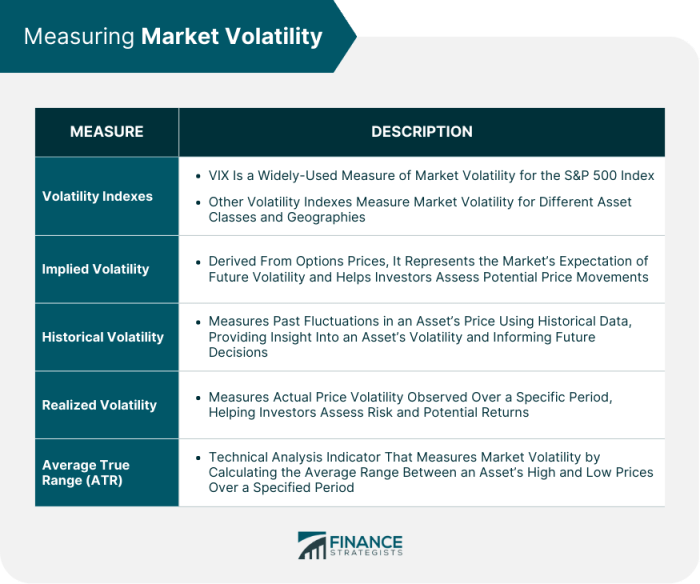
A volatility index is a measure of the market’s expectation of volatility, often referred to as the “fear gauge” in finance. It helps investors gauge the level of risk and uncertainty in the market.
Popular Volatility Indices
Volatility indices like the VIX (CBOE Volatility Index) are widely used to track market volatility levels. These indices are calculated based on the prices of options on the S&P 500 index.
- The VIX calculates the expected 30-day volatility of the S&P 500 index, derived from the prices of call and put options.
- Other popular volatility indices include the VXN (Nasdaq Volatility Index) and the VXEEM (Emerging Markets Volatility Index).
Role in Investment Decisions
Traders and analysts use volatility indices to assess market sentiment and make informed investment decisions.
High volatility index readings may indicate market uncertainty and potential price swings, prompting investors to adjust their strategies accordingly.
- Investors may use volatility indices to hedge against market risks or to time their entry and exit points in the market.
- An increase in the volatility index can signal opportunities for trading strategies like options trading or volatility trading.
Market Research and Analysis
Market research plays a crucial role in predicting market volatility. By analyzing various factors and trends, researchers can identify potential shifts in the market and anticipate volatility. Let’s delve into different methods used in market analysis to forecast market volatility and how historical data is utilized in this process.
Methods Used in Market Analysis
Market analysis employs various methods to forecast potential market volatility. Some common approaches include technical analysis, fundamental analysis, and sentiment analysis.
- Technical analysis involves studying past market data, such as price movements and trading volume, to identify patterns that may indicate future volatility.
- Fundamental analysis focuses on evaluating economic indicators, company financials, and market trends to assess the underlying factors that could impact market volatility.
- Sentiment analysis measures market sentiment through surveys, social media, and news sources to gauge investor confidence and predict potential market shifts.
Utilization of Historical Data
Historical data is a valuable resource in market research to understand market volatility trends. By analyzing past market behavior during different economic conditions, researchers can identify patterns and correlations that may influence future volatility. For example, studying previous market crashes or geopolitical events can provide insights into how the market may react in similar situations. Researchers can use statistical models and data analysis techniques to extract meaningful information from historical data and make informed predictions about market volatility.
As we conclude our exploration into What Causes Market Volatility?, it becomes evident that a multitude of factors, from economic indicators to geopolitical events, play a significant role in driving market fluctuations. By grasping the dynamics at play, investors and traders can better equip themselves to weather the storm of volatility and seize opportunities amidst the chaos.
Quick FAQs
What are the key economic indicators that can influence market volatility?
Economic indicators like GDP growth, inflation rates, and employment data can have a substantial impact on market volatility.
How do traders use volatility indices like the VIX to make investment decisions?
Traders use volatility indices like the VIX as a measure of market expectations and sentiment, helping them gauge the level of risk in the market.
Why is historical data important in understanding market volatility trends?
Historical data provides valuable insights into how markets have behaved in the past during volatile periods, guiding investors in making informed decisions.