
Delving into the realm of Market Research Strategies for Startups unveils a world of opportunities and challenges, where informed decisions pave the way for entrepreneurial triumph. As startups navigate the intricate landscape of market dynamics, the strategic utilization of research methodologies becomes their compass, guiding them towards sustainable growth and competitiveness.
From deciphering target audience nuances to decoding market trends, the journey of a startup is intricately woven with the threads of comprehensive research, offering a roadmap to success that is both dynamic and enlightening.
Market Research Importance
Market research is crucial for startups as it provides valuable insights into the market landscape, consumer preferences, and competitor strategies. By conducting thorough market research, startups can make informed decisions that can significantly impact their success and growth.
Examples of How Market Research Helps Startups
- Identifying target market: Market research helps startups identify their target audience, understand their needs, preferences, and buying behaviors.
- Evaluating competition: By analyzing competitors through market research, startups can identify gaps in the market, competitive advantages, and potential threats.
- Product development: Market research provides valuable feedback on product ideas, features, pricing, and positioning, helping startups develop products that meet customer needs.
- Marketing strategies: Through market research, startups can tailor their marketing strategies to reach the right audience through the right channels effectively.
Benefits of Conducting Market Research Before Launching a New Product or Service
- Minimize risks: Market research helps startups minimize risks by understanding market demand, competition, and potential challenges before investing resources in product development.
- Optimize resources: By conducting market research, startups can allocate resources more efficiently by focusing on target markets and strategies with the highest potential for success.
- Enhance decision-making: Market research provides startups with data-driven insights that enable better decision-making, leading to more successful product launches and marketing campaigns.
- Improve customer satisfaction: Understanding customer preferences and expectations through market research allows startups to develop products and services that meet customer needs, leading to higher satisfaction and loyalty.
Market Research Methods
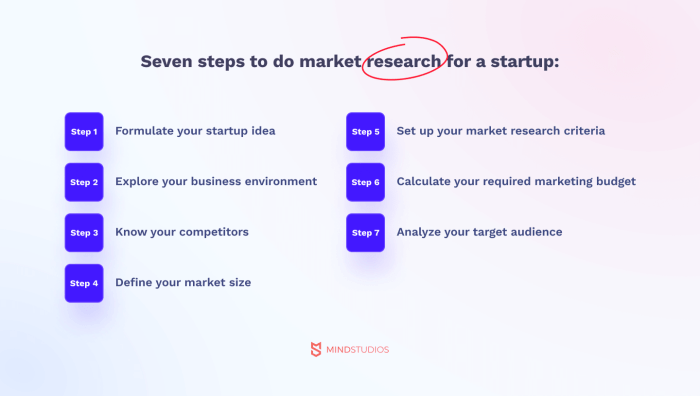
Market research methods are crucial for startups to gather valuable insights about their target market, competition, and industry trends. By utilizing various research methods, startups can make informed decisions and develop effective strategies to achieve success in the market.
Primary Research
Primary research involves collecting data directly from the source. Startups can conduct surveys, interviews, focus groups, and observations to gather information specific to their target market. This method allows startups to obtain firsthand insights and tailor their research according to their unique needs.
Secondary Research
Secondary research involves analyzing existing data and information that has already been collected by others. Startups can utilize sources such as market reports, industry publications, and online databases to gather valuable insights without the need for direct data collection. This method can provide a broader perspective and help in validating primary research findings.
Qualitative Research
Qualitative research focuses on understanding the underlying reasons, opinions, and motivations behind consumer behavior. Startups can use methods like interviews, focus groups, and observations to gather rich and descriptive data. Qualitative research helps in uncovering insights that quantitative data might overlook, providing a deeper understanding of consumer preferences and trends.
Quantitative Research
Quantitative research involves collecting numerical data and analyzing it statistically. Startups can use surveys, questionnaires, and experiments to gather quantitative data on a larger scale. This method helps in measuring trends, patterns, and correlations within the target market, providing valuable insights for decision-making and strategy development.
Target Audience Identification
Identifying a target audience is a crucial step in market research strategies for startups. It helps in understanding the specific needs, preferences, and behaviors of potential customers, allowing businesses to tailor their products and marketing efforts accordingly.
Strategies for Defining and Segmenting Target Audience
- Conduct Market Surveys: Utilize surveys to gather demographic information, interests, and buying habits of your target audience.
- Utilize Social Media Analytics: Analyze data from social media platforms to identify trends and preferences of your target market.
- Segmentation Analysis: Divide your audience into different segments based on factors like age, gender, income, and psychographics to create targeted marketing campaigns.
- Utilize Customer Feedback: Collect feedback from existing customers to understand their needs and preferences, helping in refining your target audience.
Impact of Understanding Target Audience on Product Development and Marketing
Understanding the target audience can significantly impact product development and marketing efforts. For example:
- Product Development: Knowing the preferences and pain points of the target audience can help in developing products that cater to their specific needs, leading to higher satisfaction and loyalty.
- Marketing Efforts: Tailoring marketing messages and channels to match the preferences of the target audience can result in higher engagement, conversion rates, and overall success of marketing campaigns.
- Customer Retention: By understanding the target audience, startups can create personalized experiences that resonate with customers, leading to increased retention rates and customer lifetime value.
Competitor Analysis
Competitor analysis is a crucial aspect of market research for startups as it provides valuable insights into the competitive landscape. By understanding the strengths and weaknesses of competitors, startups can make informed decisions to differentiate themselves and gain a competitive edge in the market.
Steps for Performing Competitor Analysis
- Identify Competitors: Start by identifying direct and indirect competitors in the market.
- Analyze Competitors: Evaluate competitors’ products, pricing strategies, marketing tactics, and target audience.
- SWOT Analysis: Conduct a SWOT (Strengths, Weaknesses, Opportunities, Threats) analysis for each competitor to identify areas of opportunity.
- Monitor Competitors: Continuously monitor competitors’ activities, such as product launches, promotions, and customer feedback.
Leveraging Competitor Analysis for Competitive Edge
- Identifying Market Gaps: By analyzing competitors, startups can identify gaps in the market where they can introduce innovative products or services.
- Pricing Strategy: Understanding competitors’ pricing strategies can help startups position their products competitively in the market.
- Marketing Insights: Analyzing competitors’ marketing tactics can provide valuable insights for developing effective marketing campaigns.
- Customer Retention: Studying competitors’ customer feedback and reviews can help startups improve their own customer retention strategies.
Market Trends and Volatility
In the dynamic business environment, monitoring market trends and volatility is crucial for startups to stay competitive and adapt their strategies effectively.
Importance of Monitoring Market Trends
Keeping an eye on market trends allows startups to identify emerging opportunities and threats, enabling them to make informed decisions and stay ahead of the competition.
Strategies for Staying Updated
- Regularly conduct market research to gather data on consumer preferences, industry developments, and economic indicators.
- Utilize social media monitoring tools to track conversations, trends, and sentiment related to your industry.
- Participate in industry events, conferences, and networking opportunities to stay informed about the latest trends and innovations.
- Establish partnerships with market research firms or consultants to gain access to expert insights and analysis.
Impact of Market Volatility on Startups
Market volatility can significantly affect a startup’s success by causing fluctuations in demand, pricing, and competition. For example, sudden shifts in consumer preferences or economic conditions can disrupt business operations and revenue streams.
Mitigating Risks through Research
- Conduct regular competitor analysis to understand how other businesses are adapting to market changes and identify potential threats.
- Monitor key performance indicators (KPIs) and financial metrics to assess the impact of market volatility on your startup’s operations and profitability.
- Stay agile and flexible in your business strategy, allowing for quick adjustments in response to changing market conditions.
- Seek feedback from customers and stakeholders to gauge their reactions to market trends and tailor your products or services accordingly.
In conclusion, Market Research Strategies for Startups serve as the cornerstone for informed decision-making and strategic planning, empowering emerging businesses to navigate the market terrain with precision and agility. By harnessing the power of research insights, startups can not only anticipate market shifts but also position themselves as trailblazers in their respective industries, poised for sustainable growth and innovation.
Answers to Common Questions
Why is market research crucial for startups?
Market research is essential for startups as it provides valuable insights into customer preferences, market trends, and competitive landscapes, enabling informed decision-making and strategic planning.
What are the different methods startups can use to conduct market research?
Startups can employ various methods such as surveys, focus groups, interviews, and data analysis to gather relevant market information and insights.
How can startups effectively define their target audience?
Startups can define their target audience by conducting demographic research, psychographic analysis, and market segmentation to identify specific customer segments with distinct needs and preferences.
Why is competitor analysis important for startups?
Competitor analysis is crucial for startups to understand market dynamics, identify competitive threats, and leverage opportunities to differentiate their products or services from competitors.
How can startups stay updated on market trends and volatility?
Startups can stay informed about market trends by monitoring industry publications, attending trade shows, analyzing economic indicators, and leveraging data analytics tools to adapt their strategies accordingly.


